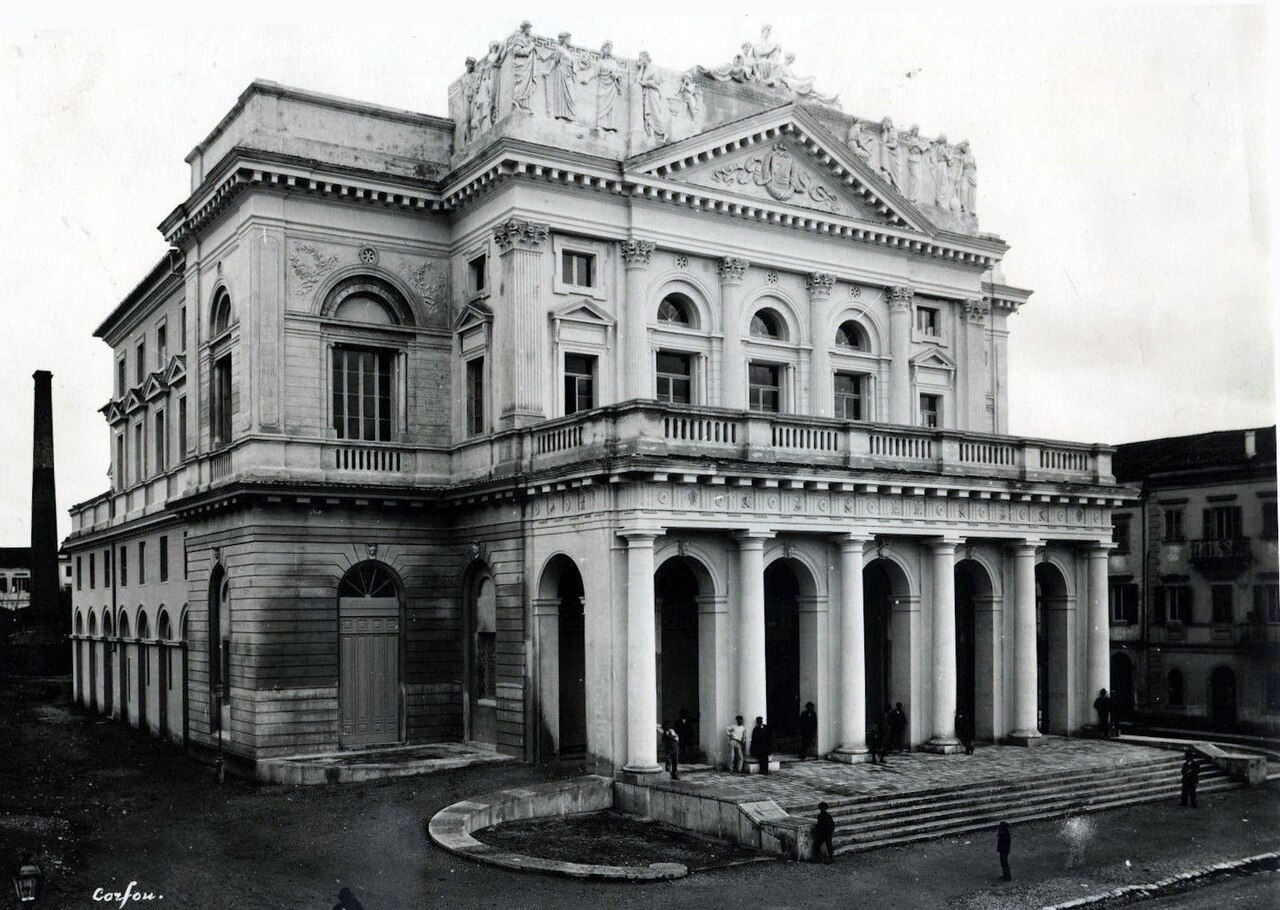
It may be an Internet mirage, but at least one archival web site suggests that it’s possible Lord High Commissioner Extraordinary William Ewart Gladstone might have sat in the audience of an 1858 production of Giuseppe Verdi’s opera Macbeth at the historic Teatro di San Giacomo on the island of Corfu. Gladstone had begun his political career in 1832 a believer that theaters “really involve the encouragement of sin,” as he told his diary in December 1832. He was described by historian Thomas Macaulay as the last hope of the “stern, unbending Tories.” But scholars say he underwent a transition in exactly this decade that led him eventually to become one of the biggest theater fans in Parliament and perhaps the strongest supporter of the creation of a national theater in England. “On no subject have his opinions undergone a more complete revolution,” as his friend Sir Robert Phillimore would go on to tell his own diary in January 1878. If Gladstone was at Macbeth, ambivalent still about opera and theater, he was there amid a fervent movement to lobby the British government he represented to have Corfu united with Greece and no longer placed under the Crown’s “protection." In that tense atmosphere, he would have heard a chorus playing the roles of Scottish refugees singing these words from the stage:
CORO
Patria oppressa! il dolce nome
No, di madre aver non puoi,
Or che tutta a figli tuoi
Sei conversa in un avel.[which translates to:]
CHORUS
Oppressed fatherland of ours! The sweet name
of mother is denied you,
now that you have become
a tomb for your sons.
Awkward!
One can imagine the ever-stolid Parliamentarian fiercely resisting the urge to squirm in his seat as the many Italian-speaking elites recognized with emotion the political implications of that sweeping chorus there in Corfu, and in Italy, where the chorus resonated with supporters of Italian unification and independence from outside oppressors. Corfu was not a war zone in 1858, as the lyrics of the Macbeth chorus suggest of Shakespeare’s fictional Scotland, but the people of the Ionian Islands did largely regard their “fatherland” as an oppressed land. Gladstone had received a mixed reception when he arrived in Corfu because those who thought he was there to liberate the Ionian Islands to join Greece welcomed him like a hero, and the many who perceived his purpose as the opposite, to establish Corfu not just as a protectorate but as a colony of Britain, received him like a villain in a 19th century melodrama.
Earlier this year, Ideational Evolution featured an article suggesting Gladstone’s brief time in Corfu may have led to his decision to give up on returning to the conservative party, whose government appointed him to serve the Queen in Corfu and join what would become the United Kingdom’s Liberal Party. Now, in the present article, I’ll explore the transformations he underwent culturally during the 1850s and after that led him to a liberal humanist viewpoint on theater, Homeric studies and art as he eventually assumed the role of undisputed icon and leader of the Liberals. Those cultural changes in his philosophy reflect growth in respect for humanity that touched almost every area of his politics, though in some ways he remained conservative. It’s an entertaining, if fanciful, notion that those changes too could have been egged on by that moving moment of operatic drama in the politically tumultuous island of Corfu.
The historical writing on Gladstone’s change of mind on theater are few and brief. Three rich if very short works appear to comprise the literature on Gladstone and the theater. Not surprisingly, none of these articles mention any theatrical expeditions in Corfu, or the role of Corfu in his intellectual journey, which is certainly understandable as I was unable to conclusively confirm even the operas I found listed as having been produced when he was there. Records of performances from the University of Bologna Corago’s web site show three operas performed in Corfu over roughly the time Gladstone was on the island: Macbeth, Pedrotti’s Tutti in Maschera and Verdi’s little-performed opera Aroldo. It is also worth noting that The Gladstone Diaries Volume 5, in which the Corfu episode is covered, makes no mention of a night out at Macbeth. The diaries were terse, so that is not final proof. It remains a compelling enough idea that it spurs the imagination.
The first of the three works on Gladstone’s theater interests gives us Phillimore’s illuminating quote from our first paragraph. It is a short subchapter entitled “The Stage” in H.C.G. Matthews’ biography Gladstone 1875-1898. It also provides good detail on what plays Gladstone watched in his later years. Secondly, a 2011 essay collates most of the available evidence on the subject. It is entitled “William Gladstone and the Theatre,” by Anselm Heinrich. Thirdly, making a case that Gladstone transitioned on his view of the theater sometime in the 1850s (at the end of which decade he went to Corfu), Glynne Wickham’s “Gladstone, Oratory and the Theatre” appears in a 1998 volume on Gladstone edited by Peter J. Jagger.
Why did Wickham believe Gladstone’s transition on the theater was made in the 1850s? “Just when his recantation respecting the theatre began remains uncertain—seemingly during the 1850s,” Wickham writes. The first concrete evidence of his transition emerges after his party switch, as late as the 1860s, as Wickham tells it. Citing Matthews, he notes that Britain was largely a pre-industrial place before the 1840s, but underwent massive changes as artisans and workers moved into towns and cities in masses for factory jobs. These and other changes, eventually including the expansion of the vote, made it necessary for meetings of thousands of people at once both in theaters and in political circles. Gladstone would go on to become perhaps the key parliamentary orator who began speaking to tens of thousands at once. Wickham wonders whether it was the necessities of new styles of speaking to large crowds that began to move Gladstone towards admiring the theater rather than excoriating it. This is a fascinating suggestion, but I wonder whether in addition to Wickham’s external evolution Gladstone may also have had a more interior transition.
It is true that Gladstone had classical literature training at Eton and Oxford, which one would expect would incline him toward receptivity to the literary medium of the theater. One of his prime occupations – and a key reason he chose to go to Corfu against the advice of nearly all his friends – was scholarship on Homer. We will see the impact that scholarship had on his ongoing intellectual evolution. He also wrote and published reviews of novels and poetry. And he was also one of the great readers of his time. The web site of Gladstone’s Library claims he read more than 22,000 books in his reading lifetime, citing the records kept in his diaries. The website calculates that this comes to about 300 books a year, or “nearly a book a day.” His library has 32,000 volumes in it, so he owned thousands more that he did not read. From that perspective, it’s not surprising that Gladstone ended up being more supportive of the dramatic literary arts than he began, as a highly religious conservative whose father was an evangelical (slaveholding, it must be noted, until the 1830s) plantation owner.
After 1858 he wasn’t just more supportive of theater. He was also more supportive of the other humanities. This is shown most clearly in his Homeric scholarship. Just as the changes in his political views were sometimes most clearly articulated in his Homeric scholarship, as my prior article argued, the evolution of his views on cultural issues were too. In 1865, only six years after his trip to Corfu, he gave a speech about the place of the Ancient Greeks in what he called the “providential order," meaning God’s plan. As David Bebbington’s The Mind of Gladstone shows, Gladstone went to his deathbed working on publications that argued that God revealed himself not only through the Hebrew Bible but also through the poems and art of the Greeks. The Greeks celebrated humanity, considered it sacred, and Gladstone gradually came around to seeing that as a good thing. By 1865 he was lecturing on the Greeks’ representation of the gods as anthropomorphic, celebrating Greek art for its beautiful depiction of the human form, and noting that Greek philosophy could “blossom because the human element was so prominent” (in Bebbington’s words). The sacredness of humanity pervaded Greek culture, and Gladstone said this was designed to act as a corrective. “I will not say to act as a corrective to Christianity,” Gladstone said, “but to act as a corrective to the narrow views that might be associated with Christianity.” Having begun life as something of an ascetic himself, these words reflected a major transition in Gladstone’s thinking. “The address was the fruit of Gladstone’s debate with his old self,” Bebbington writes. “The study of Homer had enlarged his mind and freed his spirit.” It freed him to appreciate the theater as well as Greek art.
The change in his thinking was dramatic. He went to the theater regularly, seeing all of Shakespeare’s major plays and calling the Bard “a major power” in his diaries. By the 1870s he was watching Richard III, Henry VIII, Othello and The Merchant of Venice in a single decade. He went to operas, comedies and melodramas. Wickham speculates that the increasingly social nature of the drama, which covered the same social issues Parliament was tasked with addressing, may have made it harder to maintain the prior age’s rejection of the theatrical arts.
His love of theater would only grow. After he became prime minister, he kept going to the theater, soaking in the applause of crowds who recognized him and asking to meet the actors afterwards (he was given the backstage key by Sir Henry Irving). He attended events with actors like Sarah Bernhardt and toured the backstage areas of the theaters with the stars as his tour guides. And as noted earlier he championed the cause of the theaters in Parliament.
A dramatic treatment could be forgiven for choosing to depict him at the opera in 1858. If he did show his face at Macbeth during his trip to Corfu it could have made an impact on the way he thought about the politics of Corfu, and Italy. He had already campaigned for human rights under Bourbon rule in Italy in 1851, famously, blowing the minds of those who viewed him as entirely another sort of conservative. But he had not yet come to support the notion of self-government for Italy. The image of a night at the opera changing his mind is charming. Music is powerful emotionally, and Verdi was pleading the case of his countrymen when he invented the choral scene depicting the Scottish singing under the thumb of a homegrown dictator. It was the English who came to the rescue of Macduff in the play, just as in 1864 Britain would finally release Corfu to join Greece (with Gladstone’s support). The scene in Macbeth seems to be an attempt by Verdi to repeat the success he had when he wrote the choral number “Va, Pensiero” in Nabucco, which has a very similar storyline depicting the painful exile of the Hebrews under Nebuchadnezzar. That song eventually became a sort of national anthem for the Italian Risorgimento movement. What we know as Italy now was then made up of individual states controlled in some cases by other powers, like the Austrian empire and the Bourbon Dynasty. When Gladstone left Corfu a dejected man, his proposals to bind the islands more closely to Britain under a representative government roundly rejected, he headed straight to Italy. He met with the leaders of the movement to unite Italy under a constitutional government, and when he did switch parties a few months later he cited his support for Italy as one of his top reasons for choosing to join the coalition of Whigs, Radicals and Peelites (conservatives supportive of the late prime minister Sir Robert Peel) that would eventually become the Gladstonian Liberal Party. (See John Morley’s Life of Gladstone and my prior article.)
His support for domestic rights in the United Kingdom is said to have followed his support for human rights overseas (though he did not use specifically the language of “human rights”). By 1864 he was trying to explain his way out of making a sweeping statement that was interpreted by both sides as a support for democracy in Britain. The transformation on such reform issues was less complete than on theater. He described himself at some unknown point later in life as an “out and out inequalitarian.” However, his transformation on theater and humanism stuck.
Gladstone would eventually get his national theater, though not until after his death. In 1963, long after he campaigned for such an institution, it became a reality. Why did it take so long? Perhaps Gladstone’s philosophy of retrenchment had become so popular it took nigh unto a century to get his own pet project passed. Gladstone and the liberals of his day were famously strong on fiscal austerity, and that may have contributed to keeping the government from investing in the theater the way it finally did midway through the 20th century. Gladstonian Liberalism took time to catch up to Gladstone’s personal liberalism on the subject of theater. The “Grand Old Man,” as he was known, might have shrugged at this irony, and quoted Banquo from Shakespeare’s Macbeth on the need for austerity even among the angels, who have to economize by darkening the stars in the firmament: “There’s husbandry in heaven; / Their candles are all out.” But when it came to a national theater he would have risen to his full height as prime minister, turned to his Chancellor of the Exchequer, and echoed Hamlet’s request to Polonius: “Good my lord, will you see the players well bestowed?”