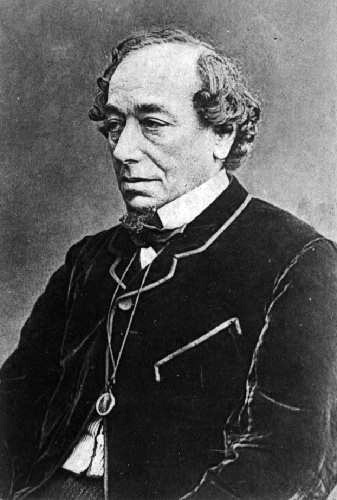
Benjamin Disraeli’s title character Tancred has traveled from London to Jerusalem, then climbed partway up Mount Sinai, to receive whatever wisdom the angels in the Holy Land are willing to impart to the world of 1847. “O Lord God of Israel, Creator of the Universe, ineffable Jehovah!” he cries, asking for a personal revelation from the divine. “A child of Christendom, I come to thine ancient Arabian altars to pour forth the heart of tortured Europe. Why art thou silent? Why no longer do the messages of thy renovating will descend on earth?” Then he spells out what Disraeli regarded as a state of the union address for Britain at that time: “Faith fades and duty dies. A profound melancholy has fallen on the spirit of man. The priest doubts, the monarch cannot rule, the multitude moans and toils, and calls in its frenzy upon unknown gods.”
In 1847, and in the years succeeding, Victorian Britain was beginning to part ways with the religious certitude that had previously defined it. Disraeli, who wrote a pair of novels back-to-back that searched for religious truth and lamented the secularization of society in 1847 and 1870, nonetheless himself was privately quite lacking in hope about religion. While publicly he emphasized the necessity of the church as an institution, privately he told a friend he expected religion to gradually become outmoded and to fade away in future generations. Thus, Disraeli’s two religious novels, Tancred and Lothair, are the laments of a man defending a cause he considered to be lost. A Jew who was converted to Anglicanism at age 12, he wrote with a passion about religion that suggests a more optimistic view. But his confessions to his friend Lord Stanley the 15th Earl of Derby, which Stanley in turn confessed to his diary, suggest a different internal state from his external one. The line is quoted in Paul Smith’s brief biography of Disraeli. It’s worth noting that Conservative peer and historian Lord Lexden suggested what Stanley calls Disraeli’s open ridicule of all religions may have been Disraeli “teasing a stuffy young man.” But Stanley himself, more than a decade later in his diaries (January 19, 1872), states that Disraeli was “incapable of religious belief.” Stanley’s impression does not appear to come from a single episode of teasing, but from years of considered judgment. Stanley added that Disraeli seemed to him sincere, ‘‘so far as I can judge," in his conviction that “a nation which has lost its faith in religion is in a state of decadence.” This is the central tension in both Tancred and Lothair. By the end of Tancred, the deadening of Europe’s faith arrives in the Holy Land, as symbolized by the arrival of Tancred’s parents in the Middle East. The novels deserve to be evaluated alongside other Victorian novels that reflect the waning of faith in Europe during the era.
“In Europe, the high moment of Christianity’s talking its way into perdition arrived in the middle of the nineteenth century, which was also the high moment of the novel’s progress,” writes literary critic James Wood, who a moment earlier had observed: “As soon as a religion seeks help from philosophy, its doom is inevitable, wrote Heinrich Heine, in his vibrant, playful little book Religion and Philosophy in Germany. ‘Trying to defend itself, it talks its way further and further into its perdition. Like any other absolutism, religion must not justify itself.’ Heine was right.”
Wood cites a long list of authors whose works were influenced by the new interest in Christ as man. “Novelists, meanwhile, began to treat Jesus as if he were the hero of a mystery tale,” Wood says. “There was a new interest in the lean Jesus of reality, as opposed to the fuller Jesus of faith. Kramskoi painted his lifelike Christ in the Wilderness. Renan, Gogol, and Melville all traveled to Jerusalem in the 1850s and 1860s. In literature, this secular tilt freed the writer and produced several fine, uncanny works.” Wood cites stories by Balzac, Tolstoy, Wilde and Lawrence, spanning from the 1840s through the 20th century, as indicative of the trend.
But he does not examine the religious works of novelist-politician Disraeli, who made the trip to Jerusalem 20 years before it was the thing to do. In fact, when his hero Tancred tells his parents he wishes to go to the Holy Land, they balk at the idea. Why not Paris, his mother wants to know? Jerusalem is poorly developed and not the place one goes. Yet Disraeli, biographer Robert Blake says, chose to go there largely to research his early novel Alroy, about a messiah figure from the 12th century who attempted an armed takeover of Jerusalem from the Caliphate.By the middle of the century Disraeli would spend more than 20 years turning his novelistic talents towards the subject of religion, first in Tancred and then in 1870 with his next novel Lothair.
The trend Wood notices is, in essence, the same trend outlined in Jonathan Parry’s Democracy and Religion: Gladstone and the liberal party 1867-1875”:
“What had also changed was the intellectual climate: in the two decades after 1845, an immense impetus had been given to the development of liberal theology and to freedom of discussion of doctrinal matters. By the mid 1860s, books as heterodox as Strauss’s Life of Jesus (translated by George Eliot, and published in 1846), Feuerbach’s Essence of Christianity (also translated by her: 1854), F. W. Newman’s The soul (1849), Greg’s Creed of Christendom (1851), the commentaries of Jowett and Stanley on the epistles of St Paul (both 1855), Buckle’s History of civilization in England (1857-61), Mill’s On liberty (1859), the collection of Essays and reviews (1860), Spencer’s First principles (1862), and Secley’s EcceHomo (1865), were among the tracts most widely discussed by those who meditated upon religious dogma. Similarly controversial, of course, were scientific works such as Chambers’ Vestiges of the natural history of creation (1844) and Darwin’s Origin of species (1859).”
Both of those last two books are addressed in Disraeli’s religious novels. In Tancred Disraeli satirizes Chambers’ work, which anticipated Darwin’s views of evolution:
“Lady Constance took up a book which was at hand, and said, ‘Do you know this?’ And Tancred, opening a volume which he had never seen, and then turning to its title page, found it was ‘The Revelations of Chaos,’ a startling work just published, and of which a rumour had reached him. ‘No,’ he replied; ‘I have not seen it.’ ‘I will lend it you if you like: it is one of those books one must read. … What is most interesting, is the way in which man has been developed. You know, all is development. The principle is perpetually going on. First, there was nothing, then there was something; then, I forget the next, I think there were shells, then fishes; then we came, let me see, did we come next? Never mind that; we came at last. And the next change there will be something very superior to us, something with wings. Ah! that’s it: we were fishes, and I believe we shall be crows. But you must read it.’ ‘I do not believe I ever was a fish,’ said Tancred. ‘Oh! but it is all proved; you must not argue on my rapid sketch; read the book. It is impossible to contradict anything in it. You understand, it is all science; it is not like those books in which one says one thing and another the contrary, and both may be wrong. Everything is proved: by geology, you know.’ … ‘I was a fish, and I shall be a crow,’ said Tancred to himself, when the hall door closed on him. ‘”
When Chambers’ book came out, Disraeli expressed excitement privately. He wrote his sister Sarah that the book was “convulsing the world.” In the end, Disraeli sided against evolutionary arguments, saying he was “on the side of the angels.” Still, his novels showed a fascination with challenges to faith in his time. Lothair specifically responded to Darwin’s 1859 On the Origin of the Species. In it, Lothair muses, through the narrator’s account of his thoughts, that “There must be design. The reasoning and the research of all philosophy could not be valid against that conviction. If there were no design, why, it would all be nonsense. And if there were design, there must be intelligence; and if intelligence, pure intelligence; and pure intelligence was inconsistent with any disposition but perfect good.” For Disraeli, Darwinism was part of the challenge to faith for his century. Megan Dent in her essay “Disraeli and the Bible” in the Journal of Victorian Culture, January 2024 cites some of the volumes in his library in the later years that showed his continuing fascination with issues of the Bible:
“One can still find on the shelves of Disraeli’s library at Hughenden works ranging from De Wette’s On the Old Testament (1806–7), to Newman’s Apologia pro vita sua (1864), William Jackson’s Doctrine of Retribution (based on the 1875 Bampton Lectures), Renan’s Vie de Jésus (1863), and several works by Strauss, including George Eliot’s translation of his Life of Jesus (1846). Knowing that Disraeli referenced the Deuteronomic history and the Gospels as he crafted his early novels, it is hardly difficult to imagine him calling upon these texts as the 1850s and 1860s introduced new threats and challenges to the Church of England and the solidity of religious establishment in general. Such was the theme of Lothair (1870), in which Disraeli responded to Darwin’s On the Origin of Species (1859), Essays and Reviews (1860), political debates over Irish church disestablishment, and increasingly contentious debates about the relationship between scriptural and scientific truth.”
Lothair tells the story of a wealthy young aristocrat who has been schooled by a Scottish Presbyterian, belongs to the Church of England, and is being courted aggressively (not without some success) by the Roman Catholic bishops. He falls in love with a succession of women each of whom represents a different religious point of view: First, he asks an Anglican woman to marry him. When she turns him down, he attaches himself to a Catholic woman who is married to God and so will have nothing to do with him. Then he falls head over heels in love with a secular humanist, whom Disraeli crafts with the greatest passion. When she dies, he returns to the first woman, the Anglican. The humanist love interest challenges Lothair’s faith. Just after the above musings, Lothair thinks to himself that “Atheism may be consistent with fine taste, and fine taste under certain conditions may for a time regulate a polished society; but ethics with atheism are impossible; and without ethics no human order can be strong or permanent.” The woman with whom he is in love at the moment, however, teaches him a humanism that places faith in individual conscience, apart from religion.
Meanwhile, Tancred, as detailed in part above, is about another young Protestant aristocrat who turns down a seat in parliament to travel to Jerusalem and the Middle East in search of a direct revelation from God. He receives such a vision, from an angel who preaches an interestingly ecumenical sermon about the “equality” of religions.
Both Lothair and Tancred see the moment in Victorian Britain as a dark one, as do others in the novels’ cast of characters. Lothair at one point laments, “We live in dark times.” His companion reaches back to the story of Noah and the ark forreassurance: “Not darker than before the deluge.” Similarly, supporting cast member Lady St. Jerome says “I don’t know how it is, but in London there seems no religion.” This is lamentable, she adds, because “religion is the great business of life; I sometimes begin to think the only business.”
By the late 1800s church was no longer the only game in town. Parry writes: “Many young men graduated from the universities in the 1860s believing that the quest for moral, spiritual and all other forms of truth could be successful only if accompanied by candid examination of the claims of all existing institutions and dogmas.”
Hence the many stories of the period that examine the institutional claim of the incarnation. Jesus is looked at as a man in all the stories Wood examines. ”Insofar as the men and women in these stories spend their time trying to uncover the true reality of their visitor they are actually applying themselves to the ‘mystery’ of the incarnation, that impossible imbrication of the godly and the human,” Wood writes. The incarnation, meanwhile, is what historian Boyd Hilton says became the frame that dictated the politics and economics of the time. In his book The Age of Atonement: The Influence of Evangelicalism on Social and Economic Thought 1785-1865, Hilton writes first of the age of atonement, during which austere economic thought was dictated by the evangelical focus on the next life. Then he writes of an age of the Incarnation, when a focus on Christ as a man set the table for more humanitarian policies that paid attention to the poor. Like Wood he lists several novels that demonstrate the new emphasis.
And like Wood he leaves Disraeli’s novels off the list. But Tancred and Lothair deserve a place on such a list of the important religious novels of the century. Tancred in particular received poor reviews for more than 150 years until a recent burst of scholarship in the last 20 that has looked back at the novel more sympathetically. Perhaps this will set the table for the first annotated edition of the novel, as it’s a major oversight in the literature that the novel lacks such treatment. The book’s conclusion has been criticized as being abrupt—Tancred’s parents show up suddenly in the Holy Land to take him back to England, ending the adventures and thematic explorations–and was for a long time assumed to be the product of haste on Disraeli’s part. Recent scholarship, however, has demonstrated the poignance of this conclusion. When Tancred’s parents arrive, it symbolizes the arrival of the new godless Europe in the only land where God reveals himself directly. The deadening of faith has arrived in the sands of the Holy Land. It’s one of Disraeli’s most careful conclusions.